Are Amazon's FBA fees eating into your profits? Surprised by how much packaging choices impact your bottom line? You're not alone. Reducing these fees is crucial for a healthy e-commerce business.
To reduce Amazon's packaging fees, audit your product dimensions to fit smaller size tiers, use custom-fit packaging to minimize volume, and certify products for programs like "Ships in Its Own Container" (SIOC). Switching to lighter materials like poly mailers for soft goods also helps.
Amazon's fulfillment fees are closely tied to the size and weight of your packaged products. By being strategic with your packaging choices, you can directly influence these costs. Let's explore the key strategies to optimize your packaging and save money.
How Do Product Dimensions and Weight Impact FBA Fees?
Unsure why your FBA fees seem so high for a lightweight product? It's not just about weight; Amazon's fee structure heavily penalizes wasted space. Understanding this is the first step to cost reduction.
Amazon charges based on the greater of a product's actual weight or its dimensional weight (volume). Using custom-fit packaging that minimizes empty space is critical, as even a fraction of an inch can push an item into a more expensive size tier.

Amazon's Fulfillment by Amazon (FBA) fee structure is designed to optimize their warehouse and shipping network. They penalize inefficiently packaged items that take up more space than necessary. This is where the concepts of size tiers and dimensional weight become incredibly important.
Audit Your Product's Size Tier
Amazon categorizes products into specific size tiers, such as Small Standard, Large Standard, and various Oversize tiers. Each tier has a different, progressively more expensive fee structure.
- The Tipping Point: The difference between being at the top of one tier and the bottom of the next can be significant in terms of fees. A fraction of an inch or a few ounces can be very costly.
- Actionable Step: Carefully measure your packaged product's length, width, height, and weight. Compare these measurements against Amazon's official FBA size tier chart. Identify which measurement is pushing you into a higher tier. For example, if the Large Standard tier limit is 18" on the longest side and your box is 18.1", you'll pay higher oversize fees.
Minimize Dimensional Weight
For many products, especially those that are large but lightweight, the 'dimensional weight' is the deciding factor for fees.
- What is Dimensional Weight? It's a calculation that carriers and Amazon use to account for the space a package takes up. A common formula is (Length x Width x Height) / Divisor (e.g., 139). Amazon uses this to determine the "shipping weight" if it's greater than the actual weight.
- The "Empty Space" Penalty: If you ship a small, light item in a large box with a lot of air and void fill, you are paying to ship that empty space. The goal is to make the packaging as close to the product's actual size as possible.
- The Custom-Fit Solution: This is where custom packaging, a specialty of ours at Finer-Packaging (MOQ 500-1000 pcs), becomes a powerful cost-saving tool. By creating a box that fits your product perfectly, you reduce the overall package dimensions, lower the dimensional weight, and can potentially move into a smaller, cheaper FBA size tier.
Verify Amazon's Data
Mistakes can happen. Amazon measures and weighs items when they enter the fulfillment center, but these measurements aren't always perfect.
- Check Seller Central: Regularly review the product dimension and weight data listed in your Seller Central account for each of your ASINs.
- Request a Re-Measurement: If you find a discrepancy between your accurate measurements and what Amazon has on file, and their data is pushing you into a higher fee tier, you can and should file a case to request a "cubiscan" re-measurement. Correcting this data can save you money on every future sale of that product.
| Action Item | Key Tactic | Potential Impact |
|---|---|---|
| Audit Product Dimensions | Measure accurately & compare to FBA size tiers | Identify opportunities to downsize into a cheaper tier |
| Reduce Dimensional Weight | Use custom-fit packaging to eliminate air space | Lower the calculated "shipping weight" and associated fees |
| Verify Amazon's Measurements | Check Seller Central & request re-measurements | Correct errors that may be costing you money |
By focusing on making your packaging as dimensionally efficient as possible, you directly address the core factors of Amazon's FBA fee calculation.
What Packaging Changes Can Directly Lower Costs?
Ready to make a change but unsure where to start? Is it about the box, the bag, or what's inside? Several strategic packaging changes can lead to immediate cost reductions on Amazon.
Switching from boxes to lightweight poly mailers for non-fragile items is a major cost-saver. Also, choosing lighter-weight materials, redesigning multi-packs for compactness, and eliminating unnecessary internal packaging components can significantly reduce fees.
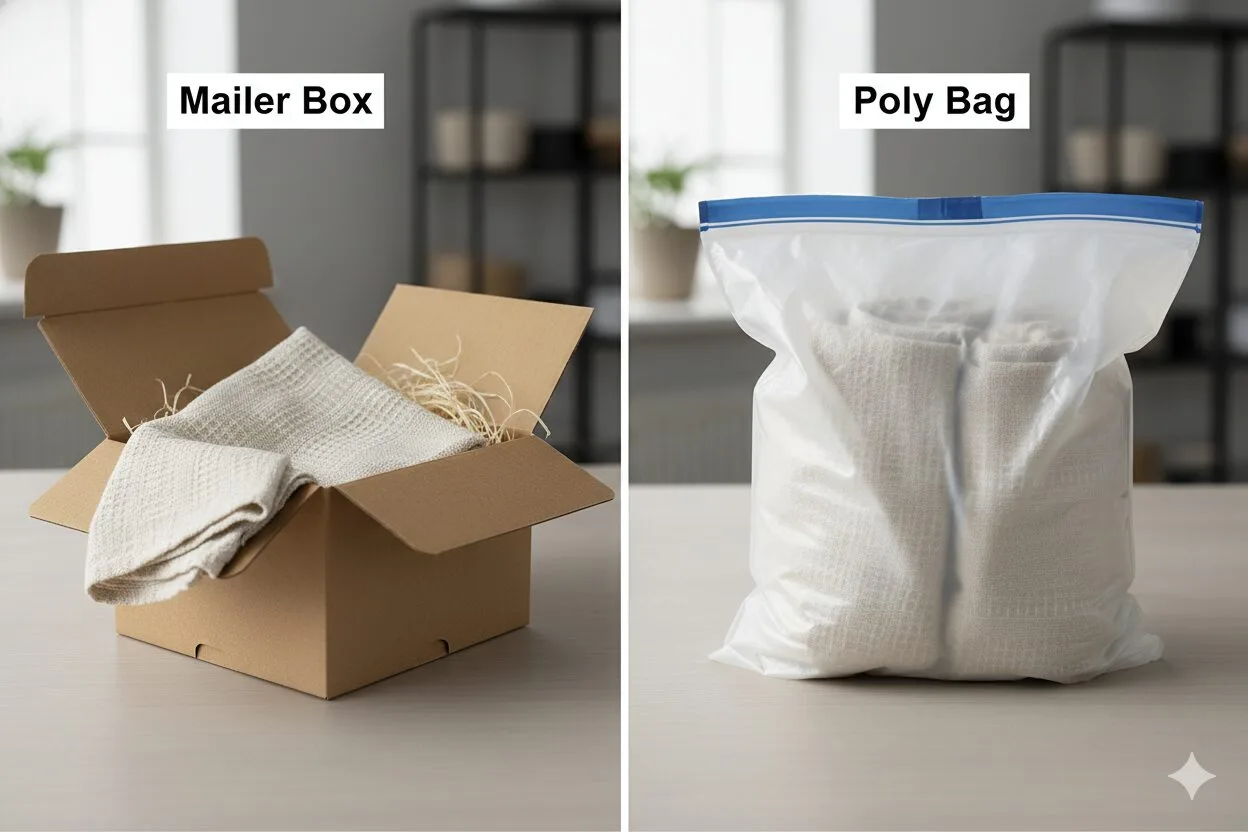
Once you've analyzed your dimensions, the next step is to make physical changes to your packaging. These adjustments focus on reducing weight, volume, and material usage while still ensuring your product arrives safely.
Switch from Boxes to Poly Mailers
For many products, this is the single most impactful change you can make.
- Ideal Products: This strategy is perfect for non-fragile items like apparel (t-shirts, leggings), fabrics, bedding, plush toys, or other soft goods.
- Why it Works: Poly mailers are significantly lighter and less bulky than corrugated boxes. This reduces both the actual weight and the dimensional weight of the package, often resulting in substantial fulfillment fee savings. A folded t-shirt in a poly mailer will almost always fall into a much cheaper tier than the same shirt in a box.
Choose Lighter-Weight Materials
Even if you need to use a box, you may not need the heaviest-duty option.
- Material Grade: Consider if a thinner grade of cardboard or paperboard could still provide sufficient protection for your product. For example, switching from a B-flute to a more slender E-flute corrugated box could reduce both weight and dimensions slightly.
- Material Type: If your product is durable, a simple paperboard folding carton might be sufficient instead of a heavier corrugated mailer. The key is to balance cost and weight reduction with the need for product protection. As a packaging manufacturer, we often help clients run tests to find this optimal balance.
Redesign Multi-Packs and Bundles
How you group multiple items together can have a big impact on the final package dimensions.
- Orientation Matters: Analyze how your multi-packs or bundles are configured. Sometimes, simply changing the orientation or arrangement of the items can create a more compact final package. Stacking items vertically instead of laying them flat, or vice-versa, might be the small change needed to fit into a lower size tier.
- Custom Inserts vs. Bags: Using a custom cardboard insert to hold bundled items together might be more space-efficient than putting them all loosely in a larger bag or box.
Eliminate Unnecessary Internal Packaging
Every component inside your box adds weight and potentially bulk.
- Void Fill: Do you really need all those air pillows or packing peanuts? If your product fits snugly in a custom box, you can often eliminate void fill entirely.
- Redundant Inserts: Review all internal packaging. Are there extra layers of cardboard, promotional inserts, or components that don't add significant value to protection or the customer experience? Removing them can reduce weight and material cost. The goal is lean packaging: everything should have a purpose.
By critically evaluating each component of your packaging and making strategic substitutions or eliminations, you can systematically reduce the weight and volume that drive up your FBA fees.
Can I Bypass Amazon's Overboxing and Get a Discount?
Tired of seeing Amazon put your nicely designed box inside another plain brown Amazon box? There's a way to avoid this and even get rewarded for it.
Yes, by certifying your products for Amazon's "Ships in Its Own Container" (SIOC) program, your item can ship without an Amazon overbox. This not only showcases your branding but can also provide you with a fulfillment fee discount.
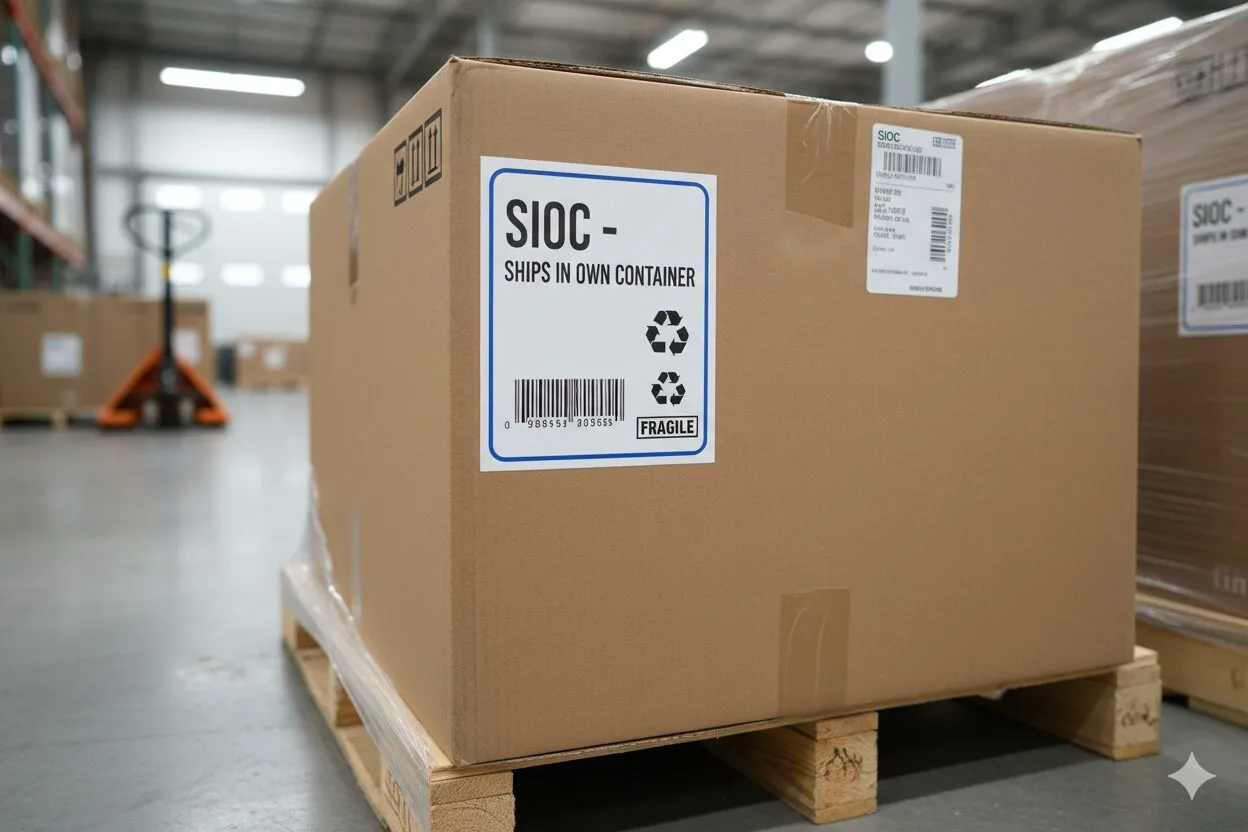
Amazon's default process is to place most items into one of their own branded boxes for shipping. However, they have programs designed to reduce waste and improve efficiency by allowing sellers to use their own packaging as the final shipping container. This is a huge opportunity for cost savings and brand building.
Amazon's "Ships in Its Own Container" (SIOC) Program
SIOC is a key part of Amazon's broader Frustration-Free Packaging (FFP) initiative.
- What it Is: SIOC certification means your packaged product is durable enough to withstand the typical shipping journey without needing any additional protection from an Amazon overbox. A shipping label is applied directly to your packaging.
- The Benefits:
- Fulfillment Fee Discounts: This is the main financial incentive. Amazon often provides a credit or discount on the FBA fulfillment fee for certified SIOC products because it saves them materials, labor, and space on their delivery vehicles.
- Enhanced Branding: Your custom-designed and branded box is what arrives on the customer's doorstep. This provides a much better brand experience than having your product hidden inside a generic Amazon box.
- Sustainability: It reduces packaging waste by eliminating the redundant overbox, which is a key goal for Amazon and many consumers.
How to Qualify for SIOC
Qualifying for SIOC isn't automatic; it requires your packaging to meet specific performance standards.
- Protection Requirements: Your packaging must be able to protect the product from damage during transit. This often means using sturdy corrugated cardboard and ensuring the product is held securely inside.
- ISTA-6 Testing: To get certified, your packaged product usually needs to pass a transit test conducted by an ISTA-certified lab. The most common test is ISTA-6 Amazon SIOC, which simulates the drops, vibrations, and compressions a package typically endures in Amazon's fulfillment network.
- Design Considerations: The box must be easy for customers to open (frustration-free) and generally shouldn't have features that could get caught on conveyor belts (like loose straps). It must also be securely sealed.
Redesigning for SIOC
Sometimes, your existing product packaging may already be close to meeting SIOC standards. Other times, a redesign is needed.
- From Product Box to Shipper: You might need to upgrade your retail-focused paperboard box to a stronger, custom-printed corrugated mailer box.
- Product Redesign (Advanced): In some cases, redesigning the product itself to be more compact or durable can help. Creating foldable or detachable parts might allow the product to fit into a smaller, stronger package that can pass SIOC testing.
- FFP Enrollment: Enrolling eligible products in the broader Frustration-Free Packaging (FFP) program can also be beneficial, as its standards are designed to promote compact, protective, and easy-to-open packaging that often qualifies for SIOC.
As a packaging manufacturer, we at Finer-Packaging can help design and produce boxes using the right materials and structural integrity to meet SIOC requirements. While there is an upfront investment in testing and potentially redesigning your packaging, the long-term savings from FBA fee discounts and the enhanced brand experience can make it a highly profitable strategy.
Conclusion
Reduce Amazon fees by using compact, custom-fit packaging and lightweight materials. Certify for SIOC to get discounts and enhance branding. Regularly check Amazon's data for accuracy to ensure you're not overpaying.